Cellular & mitochondrial · Cellular-energy coenzyme
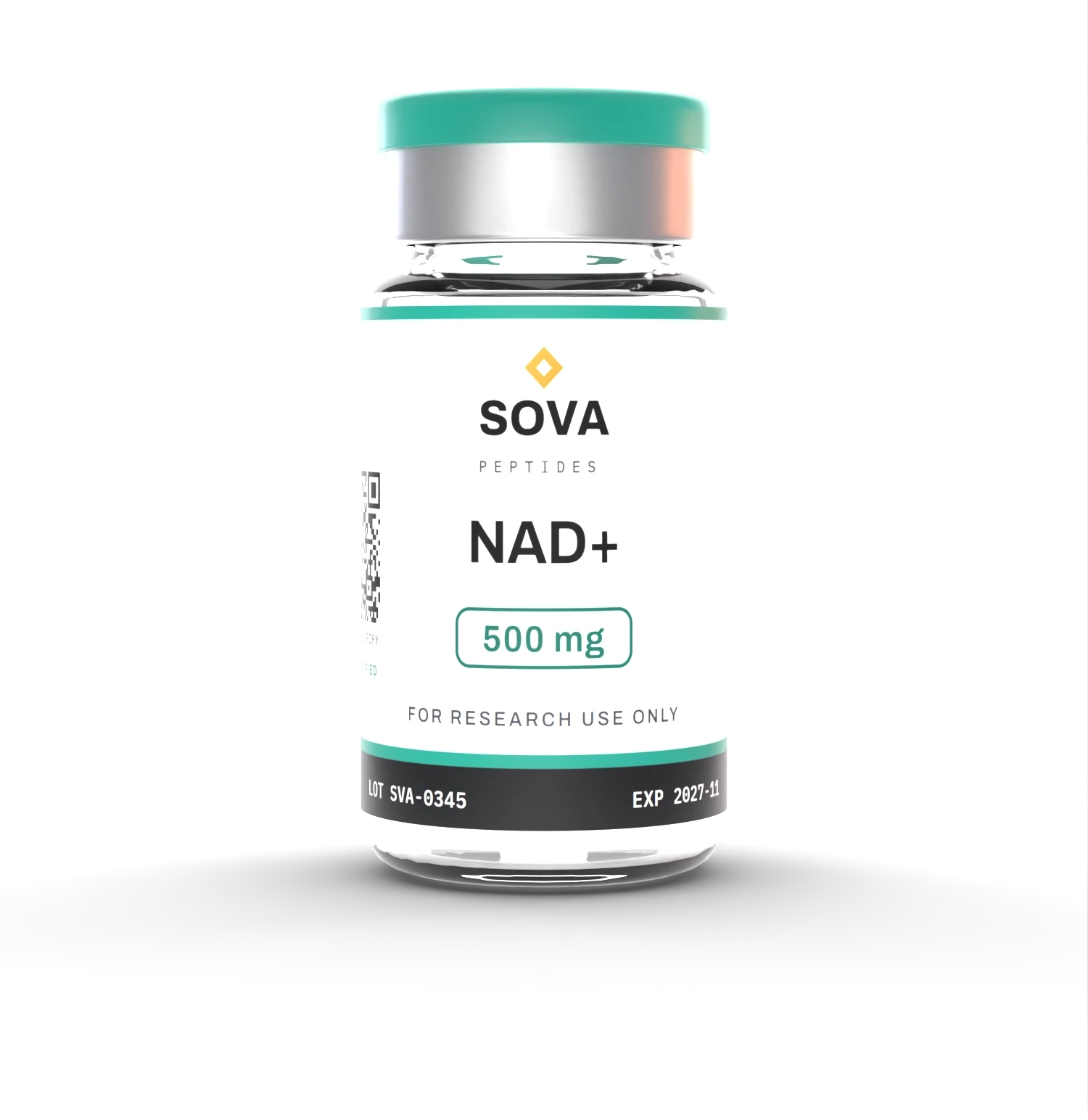
NAD+ 500mg
NAD+ supplied as a lyophilised powder for reconstitution. Reference-grade purity, mass-spec confirmed identity, and a batch-linked Certificate of Analysis with every order.
NAD+ UK buying guide →
Bundle & save · Month tiers
1 vial
Base
3+ vials
−10%
6+ vials
−18%
✓ Free UK shipping over £100 · dispatched same working day before 3pm
CoA-match guarantee — every vial matches its batch Certificate of Analysis, or your money back.
About the compound
What is NAD+?
NAD+, or nicotinamide adenine dinucleotide, is a coenzyme found in all living cells and is not a peptide. It is built from two nucleotides joined through their phosphate groups, one bearing adenine and the other nicotinamide. Sova supplies NAD+ as a research-grade powder, CAS number 53-84-9, with a molecular weight of 663.43, catalogued within the cellular and mitochondrial research category as a laboratory reagent.
As a coenzyme, NAD+ is central to cellular energy metabolism and redox chemistry, cycling between its oxidised form, NAD+, and reduced form, NADH. It accepts and donates electrons across reactions in glycolysis, the citric acid cycle and oxidative phosphorylation. NAD+ also serves as a substrate for enzymes such as sirtuins and PARPs, linking it to signalling and DNA-related pathways studied in the laboratory.
NAD+ is a major focus of ageing and mitochondrial research, where investigators examine how cellular NAD+ levels change with metabolic state and age in model systems. Studies explore its connections to mitochondrial function, redox balance and sirtuin activity. This body of work remains within controlled preclinical and laboratory research, and Sova provides the coenzyme solely to support such investigations.
Because NAD+ is a coenzyme rather than a peptide, each batch of NAD+ UK stock from Sova is confirmed by HPLC-verified purity documented on a batch-linked Certificate of Analysis. The powder is hygroscopic and heat-sensitive, so it should be stored sealed, dry, protected from light and kept frozen. Sova dispatches domestically within the UK. This material is supplied strictly for laboratory research use only and not for human or veterinary use.
Specification
Read the vial.
- Compound
- NAD+
- CAS number
- 53-84-9
- Molecular weight
- 663.43 g/mol
- Purity (HPLC)
- 99.2%
- Identity
- Confirmed by mass spectrometry
- Form
- Lyophilised powder, sterile-filtered
- Storage
- Store lyophilised at ≤ −20 °C, protected from light. Reconstituted: 2–8 °C, use within 28 days.
- Batch
- SVA-0345
Reconstitution guidance
Handled like a lab reagent.
Reconstitute with bacteriostatic water. Draw slowly against the vial wall — do not agitate. Swirl gently until fully dissolved. Store reconstituted vials at 2–8 °C and use within 28 days. Full protocol on the Certificate of Analysis.
Example dilutions · 500 mg vial
| BAC water | Concentration | Per 0.05 ml |
|---|---|---|
| 1.0 ml | 500 mg / ml | 25.00 mg |
| 2.0 ml | 250 mg / ml | 12.50 mg |
| 3.0 ml | 166.67 mg / ml | 8.33 mg |
| 5.0 ml | 100 mg / ml | 5.00 mg |
Concentration reference only — not a dosing schedule.
FAQ
NAD+, answered.
What is NAD+?
+
NAD+ (nicotinamide adenine dinucleotide) is a coenzyme present in all living cells, not a peptide. Formed from two linked nucleotides carrying adenine and nicotinamide, it is central to energy metabolism and redox reactions. Sova supplies it as a research-grade powder (CAS 53-84-9, MW 663.43).
Is NAD+ legal to buy in the UK?
+
Yes. NAD+ is supplied in the UK as a research-grade laboratory reagent for research use only. It is not a licensed medicine or supplement and is not sold for human or veterinary consumption. Purchasers handle it within an appropriate research setting.
What is NAD+ studied for?
+
NAD+ is a major focus of ageing and mitochondrial research. Investigators study how cellular NAD+ levels relate to energy metabolism, redox balance, sirtuin and PARP enzyme activity, and ageing in model systems, all within controlled laboratory conditions.
How is Sova's NAD+ verified?
+
As NAD+ is a coenzyme rather than a peptide, each batch is assessed by HPLC to verify purity. The results are recorded on a batch-linked Certificate of Analysis supplied with the reagent, allowing laboratories to confirm quality against the stated compound.
How should NAD+ be stored?
+
NAD+ is hygroscopic and heat-sensitive. Store the powder sealed and desiccated, protected from light, and kept frozen for long-term stability. Prepare solutions fresh where possible and keep any reconstituted material cold, handling it under standard laboratory practice.
Is NAD+ a peptide?
+
No. NAD+ is a dinucleotide coenzyme, not a peptide. It is composed of two nucleotides linked by phosphate groups rather than a chain of amino acids. For this reason its purity is verified by HPLC rather than peptide-specific mass-spectrometry identity methods.
Related compounds
All Cellular & mitochondrial →
Further reading
Research hub →6 min read
How Research Peptides Are Verified
How reputable suppliers confirm the identity and purity of a research peptide using reverse-phase HPLC and mass spectrometry, and what a batch-linked Certificate of Analysis should tell a researcher.
6 min read
Understanding a Certificate of Analysis
A practical, research-use guide to what a Certificate of Analysis contains, what each field means, and how to tell a genuine batch-linked CoA from a meaningless one.
5 min read
How to Reconstitute Research Peptides
A research-use laboratory guide to reconstituting lyophilised peptides — solvent choice, handling steps, concentration arithmetic and storage.