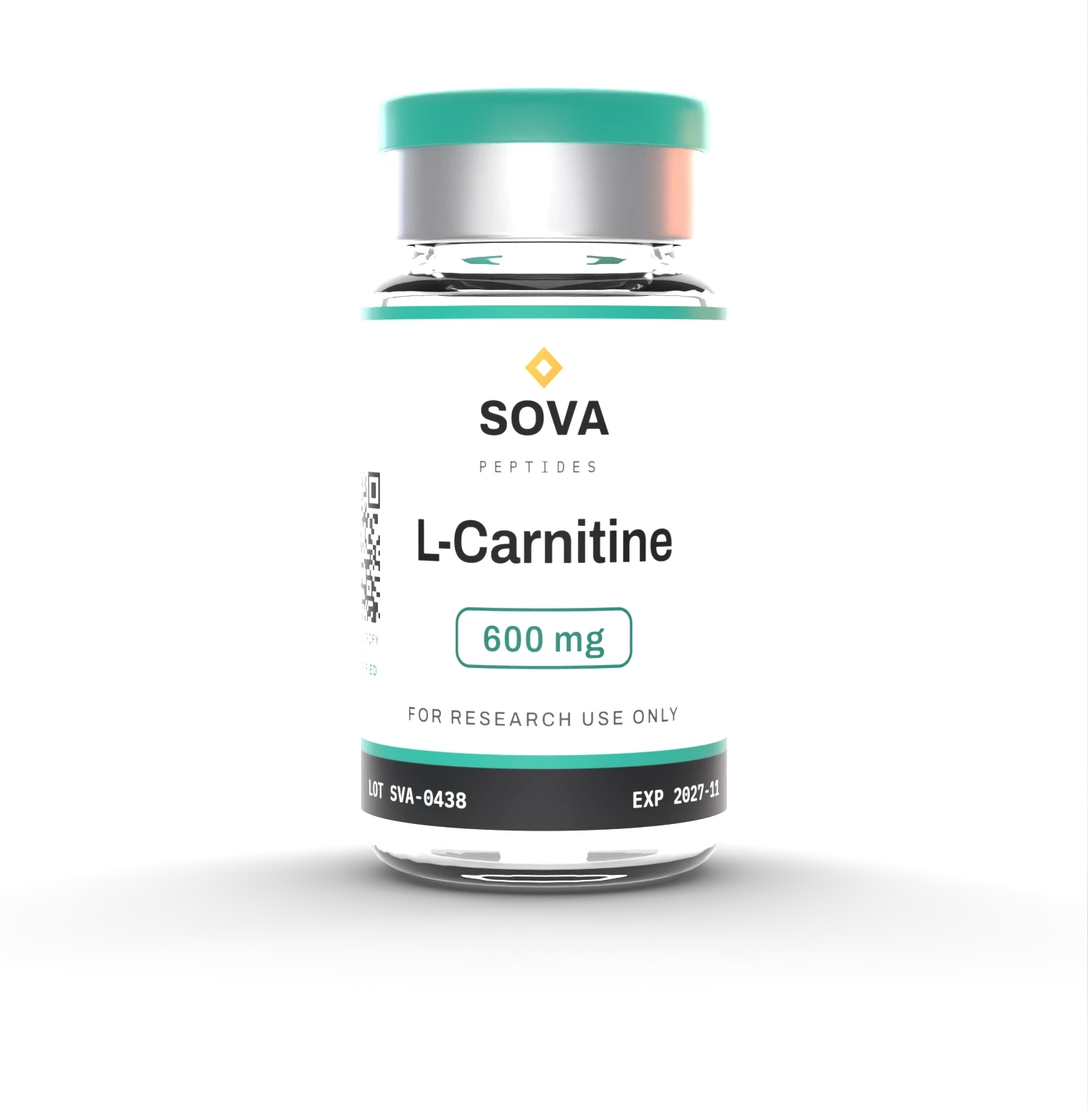
Metabolic · Fatty-acid transport cofactor
L-Carnitine 600mg
L-Carnitine supplied as a lyophilised powder for reconstitution. Reference-grade purity, mass-spec confirmed identity, and a batch-linked Certificate of Analysis with every order.
L-Carnitine UK buying guide →
Bundle & save · Month tiers
1 vial
Base
3+ vials
−10%
6+ vials
−18%
✓ Free UK shipping over £100 · dispatched same working day before 3pm
CoA-match guarantee — every vial matches its batch Certificate of Analysis, or your money back.
About the compound
What is L-Carnitine?
L-Carnitine is a quaternary ammonium compound, not a peptide, whose role is to shuttle long-chain fatty acids across the inner mitochondrial membrane for beta-oxidation. It has a molecular weight of 161.20 (CAS 541-15-1) and occurs naturally in mammalian tissue. Sova supplies L-Carnitine UK as a 600mg vial, a larger quantity suited to repeated assay work and larger-scale research preparations.
Biochemically, L-Carnitine acts as the carrier in the carnitine shuttle, forming acyl-carnitine esters that allow activated fatty acids to enter the mitochondrial matrix. Once inside, the fatty acids are released for beta-oxidation and downstream energy metabolism. This transport role places the compound at a central control point of cellular lipid handling, which is why it features widely in bioenergetics investigations.
Research groups study L-Carnitine within fatty-acid-metabolism and bioenergetics contexts, using it to probe mitochondrial substrate transport and cellular energy flux. Sova provides the compound purely as a characterised reference material for such in-vitro and preclinical work. It is offered as a defined starting material and carries no physiological, dietary or performance claim of any kind.
As a small molecule, L-Carnitine is verified by HPLC to confirm identity and purity rather than by peptide mass-spectrometry sequencing, with the results documented on a batch-linked Certificate of Analysis. Store the sealed vial cool, dry and protected from light. Sova is a UK-based supplier providing this material for laboratory research use only, and it is not intended for human or animal consumption.
Specification
Read the vial.
- Compound
- L-Carnitine
- CAS number
- 541-15-1
- Molecular weight
- 161.20 g/mol
- Purity (HPLC)
- 99.0%
- Identity
- Confirmed by mass spectrometry
- Form
- Lyophilised powder, sterile-filtered
- Storage
- Store lyophilised at ≤ −20 °C, protected from light. Reconstituted: 2–8 °C, use within 28 days.
- Batch
- SVA-0438
Reconstitution guidance
Handled like a lab reagent.
Reconstitute with bacteriostatic water. Draw slowly against the vial wall — do not agitate. Swirl gently until fully dissolved. Store reconstituted vials at 2–8 °C and use within 28 days. Full protocol on the Certificate of Analysis.
Example dilutions · 600 mg vial
| BAC water | Concentration | Per 0.05 ml |
|---|---|---|
| 1.0 ml | 600 mg / ml | 30.00 mg |
| 2.0 ml | 300 mg / ml | 15.00 mg |
| 3.0 ml | 200 mg / ml | 10.00 mg |
| 5.0 ml | 120 mg / ml | 6.00 mg |
Concentration reference only — not a dosing schedule.
FAQ
L-Carnitine, answered.
What is L-Carnitine?
+
L-Carnitine is a quaternary ammonium compound, not a peptide, that transports long-chain fatty acids into mitochondria for beta-oxidation. It is catalogued under CAS 541-15-1 with a molecular weight of 161.20 and supplied as a 600mg vial for research.
Is L-Carnitine legal to buy in the UK?
+
It is supplied strictly as a research chemical on a research-use-only basis. Sova provides it to research and professional customers as a reference material; it is not a supplement, food or medicine and is not for human or animal consumption.
What is L-Carnitine studied for?
+
In the research literature it is studied within fatty-acid-metabolism and bioenergetics contexts, where its role in the carnitine shuttle is used to probe mitochondrial substrate transport and cellular energy flux.
How is Sova's L-Carnitine verified?
+
As a small molecule it is verified by HPLC to confirm identity and purity rather than by peptide mass spectrometry, with the results recorded on a batch-linked Certificate of Analysis supplied with the vial.
How should L-Carnitine be stored?
+
Keep the sealed vial cool, dry and protected from light. Any prepared solutions should be handled and stored short-term under appropriate laboratory conditions according to your own protocol.
Is L-Carnitine a peptide?
+
No. L-Carnitine is a quaternary ammonium compound (MW 161.20), not a peptide, which is why it is verified by HPLC rather than by the peptide mass-spectrometry identity methods used for the peptides in this catalogue.
Further reading
Research hub →6 min read
How Research Peptides Are Verified
How reputable suppliers confirm the identity and purity of a research peptide using reverse-phase HPLC and mass spectrometry, and what a batch-linked Certificate of Analysis should tell a researcher.
6 min read
Understanding a Certificate of Analysis
A practical, research-use guide to what a Certificate of Analysis contains, what each field means, and how to tell a genuine batch-linked CoA from a meaningless one.
5 min read
How to Reconstitute Research Peptides
A research-use laboratory guide to reconstituting lyophilised peptides — solvent choice, handling steps, concentration arithmetic and storage.