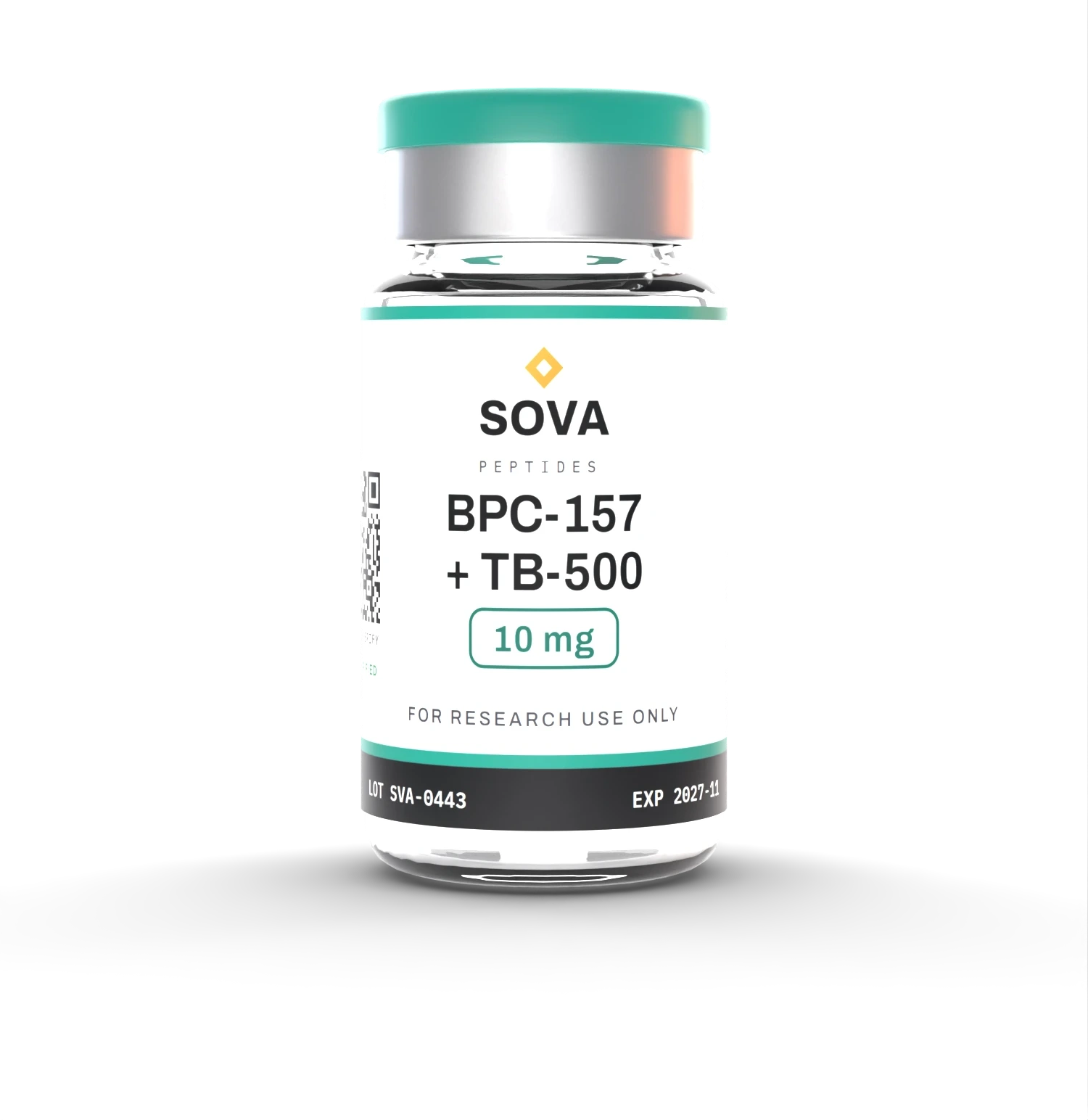
Blends · Repair blend, 5+5mg
BPC-157 + TB-500 10mg
BPC-157 + TB-500 supplied as a lyophilised powder for reconstitution. Reference-grade purity, mass-spec confirmed identity, and a batch-linked Certificate of Analysis with every order.
Bundle & save · Month tiers
1 vial
Base
3+ vials
−10%
6+ vials
−18%
✓ Free UK shipping over £100 · dispatched same working day before 3pm
CoA-match guarantee — every vial matches its batch Certificate of Analysis, or your money back.
About the compound
What is BPC-157 + TB-500?
BPC-157 + TB-500 is a pre-mixed single-vial blend of two of the most-studied tissue-repair peptides, supplied at 5mg of each for a total of 10mg. BPC-157 is a pentadecapeptide and TB-500 is a thymosin beta-4 fragment. Rather than reconstituting two separate vials, the combination is provided ready-mixed in one vial as a single, consistently prepared research sample for laboratory work.
The two peptides are studied around different but related mechanisms. BPC-157 is investigated in research literature concerning angiogenic and growth-factor pathways, while TB-500 is examined in relation to actin regulation and cell migration. Presenting both in one preparation places two distinct mechanistic targets from tissue-repair research within a single vial for laboratory investigation of their combined profile.
BPC-157 + TB-500 UK is offered because these two peptides are the pairing most frequently examined together in tissue-repair research. Combining an angiogenic-pathway peptide with an actin-regulation and cell-migration peptide gives researchers a ready-mixed sample for comparative work, removing the variability of preparing two separate vials and allowing both mechanisms of interest to be studied within one consistent preparation.
Each component in the blend is analysed by reverse-phase HPLC and ESI mass spectrometry, with a batch-linked Certificate of Analysis available for the finished vial. It is supplied lyophilised and should be stored sealed, away from light, heat and moisture, with cold storage recommended after reconstitution. It is sourced and handled in the UK. This product is sold strictly for laboratory research use only.
Specification
Read the vial.
- Compound
- BPC-157 + TB-500
- Purity (HPLC)
- ≥98%
- Identity
- Confirmed by mass spectrometry
- Form
- Lyophilised powder, sterile-filtered
- Storage
- Store lyophilised at ≤ −20 °C, protected from light. Reconstituted: 2–8 °C, use within 28 days.
- Batch
- SVA-0443
Reconstitution guidance
Handled like a lab reagent.
Reconstitute with bacteriostatic water. Draw slowly against the vial wall — do not agitate. Swirl gently until fully dissolved. Store reconstituted vials at 2–8 °C and use within 28 days. Full protocol on the Certificate of Analysis.
Example dilutions · 10 mg vial
| BAC water | Concentration | Per 0.05 ml |
|---|---|---|
| 1.0 ml | 10 mg / ml | 0.50 mg |
| 2.0 ml | 5 mg / ml | 0.25 mg |
| 3.0 ml | 3.33 mg / ml | 0.17 mg |
| 5.0 ml | 2 mg / ml | 0.10 mg |
Concentration reference only — not a dosing schedule.
FAQ
BPC-157 + TB-500, answered.
What is BPC-157 + TB-500?
+
It is a pre-mixed single-vial blend of two tissue-repair research peptides, BPC-157 and TB-500, supplied ready-mixed rather than as separate vials. It is intended for laboratory research use only and is not a medicine, food or cosmetic.
What does BPC-157 + TB-500 contain?
+
It contains BPC-157, a pentadecapeptide, and TB-500, a thymosin beta-4 fragment, at 5mg of each for a total of 10mg, combined together in a single vial as one ready-mixed preparation.
Is BPC-157 + TB-500 legal to buy in the UK?
+
This blend is supplied for laboratory research use only and can be purchased in the UK for that purpose. It is not authorised as a medicine, food or cosmetic, is not for human or veterinary use, and no therapeutic claims are made.
What are its components studied for?
+
In the research literature BPC-157 is studied around angiogenic and growth-factor pathways, while TB-500 is studied around actin regulation and cell migration. The two are commonly examined together in tissue-repair research.
How is BPC-157 + TB-500 verified?
+
Each component is analysed by reverse-phase HPLC and ESI mass spectrometry, and the finished vial is supplied with a batch-linked Certificate of Analysis so the material can be traced to its production batch.
How should BPC-157 + TB-500 be stored?
+
Store the sealed lyophilised vial away from light, heat and moisture. Cold storage is recommended once the material has been reconstituted, and the vial should be handled only within an appropriate laboratory setting.
Further reading
Research hub →6 min read
BPC-157: A Research Reference Guide
A neutral overview of the synthetic pentadecapeptide BPC-157, its sequence origin, the tissue-repair and angiogenesis pathways studied in preclinical models, and how it is characterised for laboratory research.
6 min read
BPC-157 vs TB-500: A Research Comparison
BPC-157 and TB-500 are two structurally distinct synthetic peptides with different origins and different studied mechanisms, frequently referenced together in tissue-repair research.
6 min read
How Research Peptides Are Verified
How reputable suppliers confirm the identity and purity of a research peptide using reverse-phase HPLC and mass spectrometry, and what a batch-linked Certificate of Analysis should tell a researcher.